
Trending
This story is from September 30, 2023
Miraculous rescues, but 30 years on, fear still hounds Latur earthquake survivors
Thirty years ago, an earthquake struck the villages of Latur and Osmanabad districts in Maharashtra, India, changing the lives of thousands. Many people were trapped under their homes, and the region received continuous rainfall, impacting rescue operations. The government provided shelters, initially using bamboo structures and later building concrete reinforced homes. However, some survivors still live in tin sheds, finding it difficult to move on from the trauma. The earthquake resulted in the deaths of nearly 10,000 people and had a lasting impact on the affected communities.
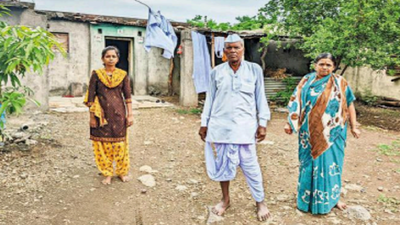
Apparao Kurale stands outside his home with his family
Apparao Kurale, now 60, never recovered from the devastation.
He, his wife, four children, parents and brother were trapped under their home in Killari village, the epicentre of the 6.4 Richter scale temblor that night in 1993.

When the earth shook under them, the roof of their mud house came crashing down. "I was trapped neck below in soil for seven hours before I was rescued. No one else at home survived. Since then, I have only wanted to know why I lived. I am not able to work with my damaged spine. No amount of compensation will ever fill the void in my life," he said, sitting on a charpoy in his government-built home in the new Killari village, on slightly elevated ground about 5km away.
The region received continuous rainfall in the days after the earthquake, impacting the rescue operations.
The state administration and rescuers from all corners of the country came in with food, shelter and clothing supplies. The biggest and immediate challenge was to provide shelter from the rain and prevent spread of diseases.
Most survivors initially lived in cattle sheds, bamboo structures in the open fields for the first few days and months, till the tin sheds were built. Later, over the next three years, the government built concrete reinforced homes that could survive earthquakes. They have served as a template for the Bhuj and other earthquakes.
Kurale points to the tin roof over his head and says the sheets were the first shelter he got. "I cannot live in a concrete structure now. These tin sheets are what I call home," he said.
The quake brought down the imlyachi ghar (mud and stone houses) like a pack of cards. According to government estimates, nearly 10,000 people died, and thousands were injured in the most devastating earthquake to have ever hit Maharashtra.
Killari resident Sharad Bhosale wishes that his family had built a brick and mortar home back then. He was studying in a college in Latur city, 40km away, when the news of the earthquake broke. He rushed to Killari on a friend's bike.
"I was shattered. The entire village was in ruins. I lost nine members of my family __ my father, uncles, aunts and cousins had died. Only my mother, sister and her baby survived," Bhosale, now a supermarket owner in Killari, told TOI.
Bhosale's family was a major player in Killari's famous grain market then. He said his father and uncles would run the business and the farming.
The grain market today is a shade of its glory days in the 90s when it was home for the urad, tur, jowar and wheat trade. Only the locals and small farmers come here for trade now.
"I had to give up my plans overnight and shoulder the responsibility of running the home. I quit my studies and started the grain trade business again. The market, however, did not regain its glory," he said.
Bhosale said he soon realized that the government help would not last a lifetime. "I want to tell everyone to be prepared for any eventuality in life. We cannot keep expecting the government and agencies to keep helping us. We must stand on our feet," he said.
Some ten km away, Sastur village had reported the highest loss of lives in the earthquake.
An estimated 1,200 people died in this village alone. Vijaykumar Kshirsagar has still not come to terms with the loss of his brother, sister-in-law and two-year-old nephew.
"My parents survived because they were sleeping on the farm. My mother, Indutai, suffered from depression all her life," he added.
His wife, Yogita, who came to the family after the earthquake had shattered their lives, said the initial years were very difficult. "Till she passed away in 2008, my mother-in-law could not come to terms with the loss. She would speak incoherently," she told TOI.
Vijaykumar is a farmer but says it is not enough for the family. He was pursuing a science degree in a college in Umerga town at the time of the quake.
Three years later, he decided to continue his studies but could not abandon his family. He completed his graduation through external examinations and now also works as an insurance agent.
"I keep thinking of how my life would have been had the quake not happened. No one knows, but frankly, life changed forever in that one minute," he told TOI.
End of Article
FOLLOW US ON SOCIAL MEDIA









Photostories

Hot Picks
TOP TRENDING
Popular Categories
Hot on the Web
Top Trends
Israel Hezbollah WarMost Runs in International CricketVirat KohliIND vs BAN Live ScoreRohit SharmaIndian Team Fastest Test FiftyMohammed SirajUGC NET Result 2024TS DSC Results 2024Women T20 World Cup Points TableWomen T20 World Cup ScheduleShane McMahon Net WorthHezbollah ChiefTourists Not AllowedDiddyTop Management Colleges of IndiaLive Cricket Score
Trending Topics
Devara CollectionMithun ChakrabortyKangana RanautNavratri WishesGandhi Jayanti WishesAnant AmbaniDevara CollectionGandhi Jayanti 2024Masala OmeletteEmergencyDevaraTaaza Khabar 2 Twitter ReviewDevara Movie ReviewHealthy RaitasSwatantrya Veer SavarkarColdplay India tour 2025Smartphone DealsApple Macbook Air M1Amazon SaleWordle Answer
Living and entertainment
Latest News
iVoomi S1 Lite e-scooter launched at Rs 84,999: 180 km range, three-year warranty!Tata Nexon turbo CNG: Variant-wise features with price explainedPMI in India intensifies efforts against Illicit Tobacco Trade to Safeguard Economic Interests and Consumer ProtectionBarbra Streisand pays tribute to late 'A Star Is Born' co-star Kris Kristofferson: 'He was something special'Sasikumar and Simran join hands for a feel-good, city-based entertainerMumbai vs Rest Of India: Irani Cup tie offers chance for hopefuls and rejects to impress selectorsOlivia Culpo and Christian McCaffrey buy George Clooney's mansion for $14.5 millionRG Kar case: Kolkata court extends judicial custody of ex-principal, suspended cop till October 4When Dikembe's shoe size astonished the Mumbai Temple guardHow can Ben Stokes and other overseas players avoid a two-year IPL ban?"Nothing he was doing was believable", Darby Allin picks names wrestler who benefited most from AEW All In 2023 backstage incidentColleagues remember braveheart Delhi Police constable Sandeep: 'Would rush to crime scene alone'Header: Kolkata metro conducts public awareness campaign at Dum Dum metro stationBengaluru resident exposes fake Flipkart agent attempting to deliver bogus iPhone 15; read online reactionsBihar and Jharkhand among top two states enrolling for contributory pension scheme for farmers"Tyler Huntley’s 'Snoop' Nickname: The Rapper Connection Explained”BTS star V crowned 'Most Handsome Man in the World 2024'Decoding a bowl of Idli Sambhar: From calories to nutrients
Copyright © 2024 Bennett, Coleman & Co. Ltd. All rights reserved. For reprint rights: Times Syndication Service